Wednesday, January 10, 2018

Building A Navy, One Foot (or 30 Centimeters) At A Time, Part II - The Game Changing Motor

Before we go on to the next batch of models, I feel it is important to cover an important topic, motive power.
As mentioned in Part I, the Lindberg models relied mostly on an electric motor that the builder had to make themselves. It was a bit complicated for the novice, though many did so with no problems.
This motor was a single magnet unit, and could run reliably enough on 3 volts. Still, the simple fact that it had to be made by the hobbyist was a slight, though not insurmountable, problem.
Other companies were relying on other small, low voltage electric motors for their kits. The bulk of these motors came from Japan. Like the Lindberg kit motors, they were single magnet and low voltage. Some had twin magnets and were were a bit stronger. 

3 VDC motor, probably a TKK, from an ITC model

They were still a little weak, however, and not as efficient as they could be.
Enter the Mabuchi F series, and the 130

A modern 130 type motor

The little 130 class motor had two magnets, could run on as little as 1.5 volts DC,  was smaller and lighter, and was inexpensive to manufacture. By the late 1960's, it was becoming ubiquitous. 

Comparison between new and old

The Mabuchi 130 was also more reliable than the previous motors, with lower draw, so not only allowing for increased battery life, but allowing for smaller batteries to be used. With the arrival of alkaline batteries, it meant that model ships could now run for extended periods of time. 

The stage was set for the next revolution in small electric powered model ships.

Tuesday, January 9, 2018

Building A Navy, One Foot (or 30 Centimeters) At A Time, Part I - The Lindberg Kits

Lindberg's Contributions

The first kits we'll discuss are those of the American Lindberg company. These started appearing in the late 1950's, and as initially sold, were intended to be motorized. All are almost exactly 12" (30.5 cm) in length.
This list is approximately the order in which they were released. All have been in production up until recently, and the company that currently holds the dies, Round2, re-issues them from time to time.  The recent production runs are no longer motorized, but the kit components to make them thus are still included. They are notable by their not being mentioned in the instructions. Like many Lindberg kits from this era, the details are sometimes a little lacking or sometimes spurious, such as the oversized and somewhat inaccurate panel lines.
A note about the motors that were sold with the kits. These were in kit form, with an off axis bar magnet and an armature that you had to wind (Speaking from experience, I was never able to get one to work. However, I was also fairly young).
All models are from my personal collection, some with older style boxes. Stated scale will be included, along with corrected scale in parentheses.

Q-Ship 1/390 (?)


Possibly the oldest of the group. When this kit was reintroduced by Round2 it had been out of production for over four decades. It represents a World War II era decoy (Q) ship, possibly the USS Atik. However, it is very similar to any small steamer built from 1910 on to about 1941, and in fact with some modifications can represent smaller or larger ships. However, the deep hull really works better for its stated scale or smaller vessels. 


US Navy Fleet Tanker 1/525 (actually 1/501)


Another old Lindberg kit that hadn't seen the light of day in decades. This one has a slightly easier to work with one piece hull, and looks the part well enough. However, it is either a Kennebec class (at the model's stated 1/525) or a Cimarron class (at 1/501). As the kit was originally offered as the USS Neches, a Cimarron, it's hard to tell, but I am certain that measuring the beam could determine which is right.
Incidentally, might also make a good basis for some escort carrier conversions.

( UPDATE - 6 Sept 2020
It has been brought to my attention that the values I presented here are in error. First, the kit most likely represents a Kennebec derived design, making the kit closer to 1/501. The Cimarron's were longer vessels, if outwardly similar. Second, the USS Neches was a Mattaponi class, a sub-group of the Kennebec class. I apologize for the sloppy research where this was concerned. I'd like to thank Davidp (via eBay) for informing me of the mistakes. RL)


USS Shangri-La 1/900 (1/888)

  
This model represents a post SCB-125 modernized Essex class carrier and has been sold as various ships, whether accurate or not. On this kit, we see the introduction of a detachable centerboard or false keel designed to keep the ship upright and afloat. The air wing is truly 1950's aircraft, including the hard to miss F7U Cutlass and F4D Skyray. Later incarnations of this kit included the same air wing, plus a Mercury capsule (really out of scale for the model). Also, the model was sold as the Antietam, which never received the full modernizations.


(Note - tiny Mercury capsule just above center)


USS Missouri 1/900 (1/887)

  
Back to a one piece hull. Not a bad interpretation of a World War II era Iowa (though each ship had differences). However, I've always thought that the turrets were a little undersized, while the tower and second smokestack were a little short. When built, however, these are not too much a detraction. Rather nice looking hull. 


USS DeLong 1/300  (1/306)


One of only two Rudderow class destroyer escorts made as an injection molded kit (the other one was a smaller kit, also from Lindberg). Like most of Lindberg's kits, the panel lines are wrong, and the hull looks rather boxy (a concession to its being a running model), bur from the deck up is actually a notch above many of their other kits. It has been sold under several different names. Also, the false keel makes a return, albeit deeper.


USS Manchester 1/600 (1/608)

  
A Cleveland class light cruiser. One piece hull, also requiring the false keel/centerboard. Like the Lindberg Rudderow DE's, also a fairly boxy hull. This model has never really looked right to me, though I haven't taken the time to properly compare it to accurate drawings. It includes a short false keel. Also, makes a good starting point for an Independence class light aircraft carrier. 


The Also-Rans

The two following kits came a few years after the previous kits, around 1967, and while still not the best (the panel lines, for instance) were fairly decent looking models.
However, they were never sold as motorized.
A look at both kits seems to indicate that Lindberg may have actually been planning to sell them that way, as both models come with one oversized screw and hints of shaft openings. Around the same time that these models were released, Lindberg released a series of smaller model warships that were much simpler and bordering on crude (a subject for later). The two larger models were really a leap beyond them.

DKM Scharnhorst 1/762 (1/771)


This kit captures the lines of the Scharnhorst rather well. Some details are a little rough, as typical, but overall, it really builds up nicely. With some work, could be converted into the Gneisenau. Main turrets appear a little off. 


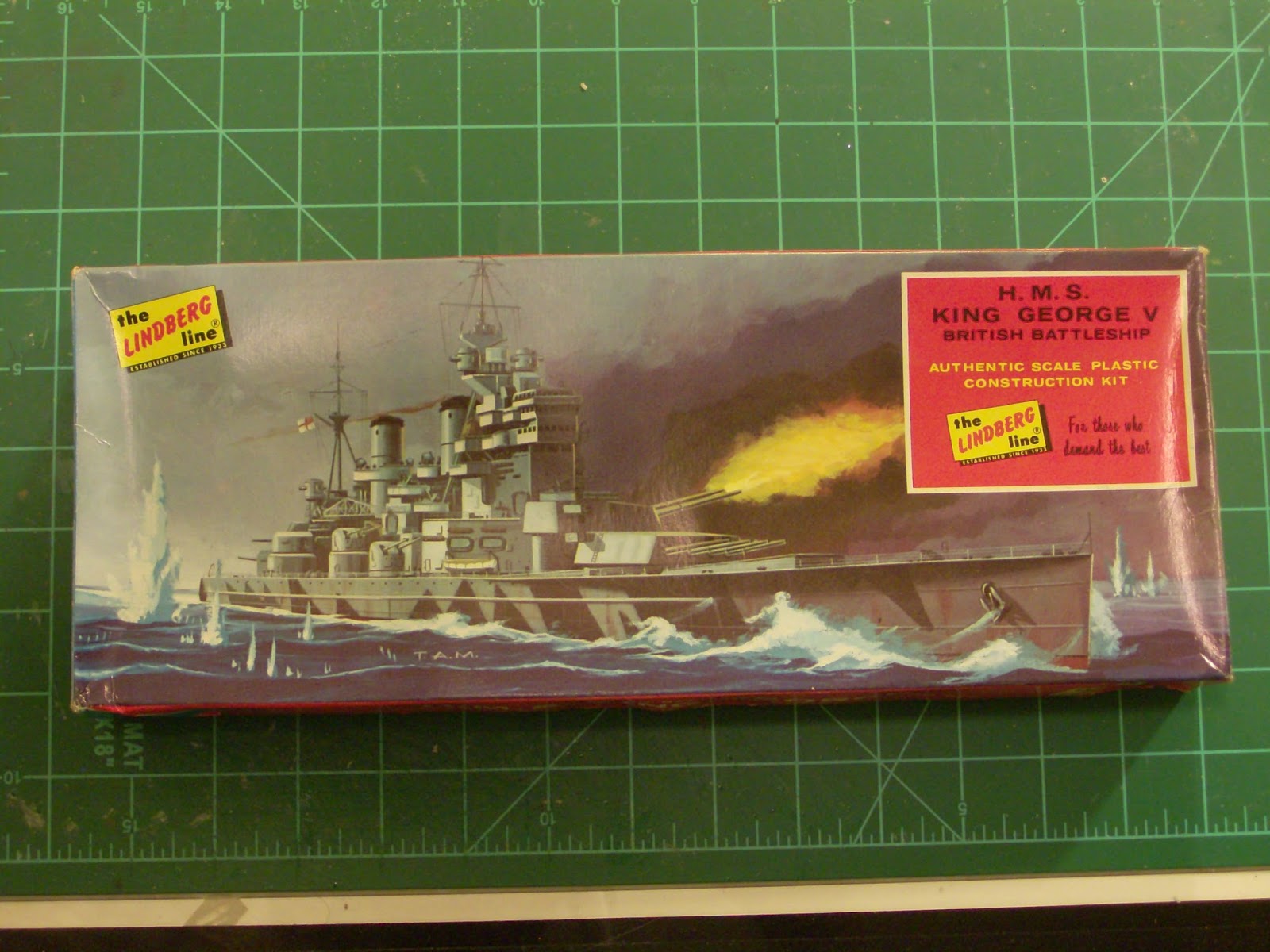
HMS King George V 1/750 (1/743)


To my knowledge, this kit was always sold as the KGV, whilst its smaller stable mate, released at the same time, was sold variously as the "Prince of Wales" and the "Duke of York". This kit represents the KGV after the aircraft were removed. This model might have been a better candidate for motorizing than the Scharnhorst, due to the hull being slightly deeper. However, the hull of Lindberg Iowa's were also fairly shallow, so like everything with regards to these two last kits, it is only speculation. 


That covers the American manufactured kits for our small fleet. Next, we'll look at one company's amazing output and its models of similar size.

Monday, January 8, 2018

Building A Navy, One Foot (or 30 Centimeters) At A Time - Introduction

The Genesis of A Small Idea - 

Like many maritime historians and hobbyist I know, I became interested in things nautical via models. Being from a working class and poor background meant that my model building was restricted to smaller models, the ones usually found at discount stores. Most of these were on the small side, and many could be motorized. 
By small, I mean usually between 10" to 14" (25.4 to 35.6 cm). 
In short, small.

In the world of model aeronautics, there is a category known as "Peanut", or various other small nuts. These are small models, with wingspans between 8" to 14" (20.3 to 35.6 cm). Most are free-flight, but with the advent of miniature RC, very small scale controlled electric flight is now possible. 
What I am think is the model ship equivalent for both free running and RC models. Very small models ships have a number of advantages over small aircraft, such as the ability to handle a little more weight for things such as batteries. 
What we need is to apply the Peanut philosophy to running model ships.
Smaller model ships are ideal for smaller bodies of water, such as pools or ponds. They are a lot cheaper, a lot easier to store, and do not need to be as detailed as larger models (though you can super detail as you desire). 

What this series of articles is going to concentrate on are a few smaller, long lived kits, with a focus on those in the 30cm and 12" range.  A good number of these models leave much to be desired as accurate or detailed scaled models, but for simply having fun, most are superb. 
These reviews are not going to be very critical, though I might add a few notes about proper scales and appearances, or pointing out obvious problems. This is a lighthearted approach, for fun. 
I suspect, however, that my tendency towards historic information will creep in, as I am a creature of habit. 
So, let's have some fun, shall we?

Saturday, January 6, 2018

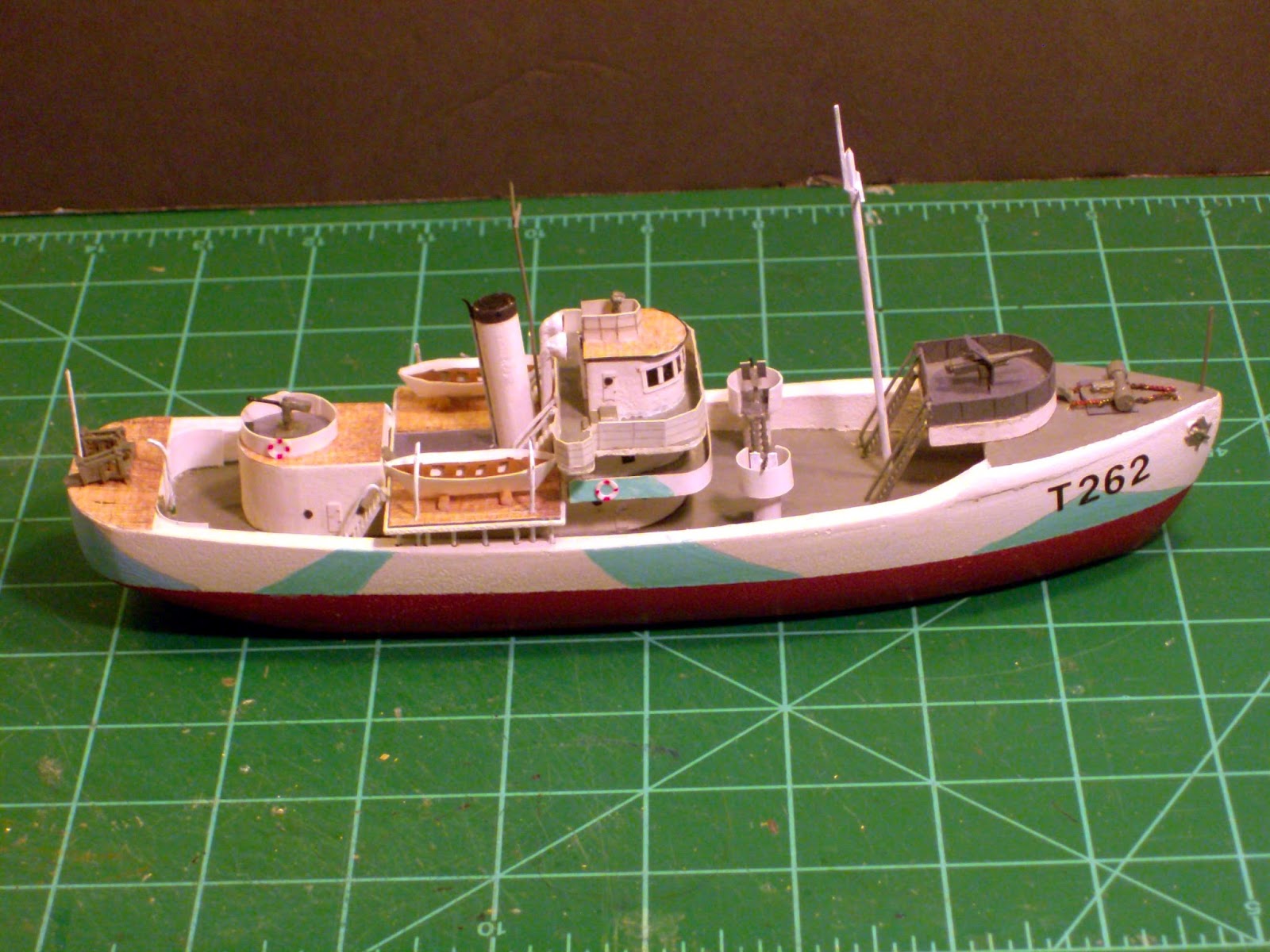
The HMT Chinook, A Freelance Admiralty Trawler In 1/240 Scale

From a simple wooden kit, this armed trawler emerged.

When I began my slow creep back into model warships, and trying to decide on interesting subjects, I rediscovered the Royal Navy Admiralty trawlers. These ships were built in scores during both World Wars, and were based upon readily available designs already being produced at smaller shipyards. This allowed for rapid construction, and many were built. 
Initially, I thought about using one of the commercially available plastic kits, but soon put the idea aside. 
A couple of months back, I picked up a very inexpensive wooden model (toy, really) tugboat. As a tug, its shape wasn't terrible, though most of the parts were very simple, and dare I say, crude. Still, I felt that there was potential here. 
When I did decide to begin construction, however, my mind wondered back to the Admiralty trawlers. 
As a result, I decided that I would build this model up as a test bed. In shape and proportion, it is simply wrong as an armed trawler, possessing too much beam. However, in profile, it looked pleasing enough above the waterline that I decided to proceed. 
In the end, the resulting model borrows heavily from the Fish-class trawlers that the Royal Navy used during the Second World War, and scales out to roughly 1/240 scale. It is painted in Western Approaches camouflage. The model allowed me to rebuild some of my skills and, more to the point, regain my confidence. 
It is still a bit rough, mind you. The sides are very thick, there is no screw nor rudder, it still needs to be sealed, and the motor mount attached. But it does appear as though it is ready to patrol the local ponds and pools in pursuit of the dreaded U-boat menace. 


Saturday, December 30, 2017

The Hidden Powerplant - The Submarine Motor

A model Admiralty trawler and its means of propulsion.

In the summer of 1976, my best friend Craig and I undertook a crash course in model ship construction. I already had some experience, as did he, but what we wanted to learn was how to build powered models, hoping to ultimately lead to radio controlled.
My first experience in building a motorized model ship resulted in a mess (more on that soon). The next attempt, with a large Lindberg Tirpitz, was a bit better. Still, we wanted to learn how to motorize smaller models.
The solution was the submarine motor.
Well, that was one name for it. We called them torpedo motors as well. These had been around since at least the 1960's, and Craig had two.
We began experimenting in earnest. We would attach the motors to the underside of the ships with rubber bands, oftentimes ignoring model details as we did so.
The models were taken to the pool at the apartment complex where he lived, where we let them run all hours of the night.
Soon, we out of AA batteries, so we resulted to using larger cells, sometimes up to D size, using a combination of stopping tape and wire to accomplish the task.
With the heavier cells, the models handled a bit poorly, but could now run longer.
Once, we got the crazy idea to assemble a series of batteries to see how much speed we could get out of one of the units. At one point, this included a crazy combination of C and D cells, four in total, 6 volts going into a motor designed for 3. We tested that combination under his USS Montrose.
There were kids in the pool, so the waves were monstrous for the small model. Still, once we twisted the two wires together, the motor kicked in, sounding like a dental drill, and the model took off like a heavily loaded speedboat.
By the end of autumn that year, the experiments stopped. I'm not sure why exactly. Perhaps it is because, now as eighth graders, we were "moving on", which for us meant model airplanes. Maybe the motors died, which was entirely possible. Whatever the reason, those experiments ended.

Now, a few decades later, I am once more playing with motorized model ships, and once more, the submarine/torpedo motor is playing a role. Today's motors are still the same basic design from my childhood, but are far sturdier. My current motor is from Tamiya, and was purchased with a small boat hull (which will soon be put to use). Tamiya isn't the only manufacturer of them today. Playmobile also makes them. Like the classic design, the run on a single AA battery and power up by twisting the forward end.
In the picture, mine is sitting in front of my latest project, a wooden model Admiralty trawler, which it is to motorize.
That's another story.

Friday, December 29, 2017

Taking A Different Tack

It has been well over a year since I last posted here. Much has happened during that time, but my love of ships has not diminished.
However, there will be some interesting changes.
Over the next few months, I am going to begin writing about and posting what got me into maritime history and modeling to begin with, model warships. Not just any, mind you,
Models that are motorized, or can be.
Most of these will be older models with a few exceptions. And of those, many will be small, toy like. They will be finished much as I would have liked to when I was much younger, except that I am shying away from much aftermarket details, due to the delicate nature of most of it. Any additional detailing I do will be done by my own hands.
This should be a lot more fun, to be honest. Inside, know that I am still a researcher, but for now, the inner fourteen year old wants to see what can be done with the models of his youth.

Monday, April 11, 2016

The Dover Cut & Assemble "Santa Maria", A Paper Nao


It took three months, but I finally completed my Dover Cut & Assemble "Santa Maria". As I mentioned some weeks back, this was my first complex paper model sailing ship, and the end result has proven to be better than I was hoping.
A few particulars about the model. The scale appears to be 1/96. Many components of the model were replaced with wood, and in the case of the sails, fabric. The rigging plan is an interesting story. Normally, whenever I build a model of someone's interpretation of a ship, I do my best not to make changes; this is a model based upon their work, not mine. In a way, I'm honoring their work. However, the rigging plan on this model is very simple, and as I was adding detail, it was necessary to fill in the blanks. Several sources were consulted, notably the works of Björn Landström and the woodcuts of Master W of the Key (W.A.).
As a kit, there are a small number of problems building the model, but I put those off to inexperience. There are some fit problems, and a few parts had to be replaced. Again, probably a lack of experience on the builder's end.
There are a number of minor issues with the model design itself. First, it has a square stern. This is a matter of some contention amongst many maritime historians, but the consensus is that the "Santa Maria" likely had a round stern. It's most likely that square sterns on naos and other round ships started appearing either at the end of the 15th century, but by the 16th century were common. The top sail is rectangular, pointing to an earlier period (like that of the actual "Santa Maria"). The model probably more closely resembles Magellan's ship "Victoria" (a possibility for a future project). The flags on this model were common up to 1504, so it could be a small nao of the very early 16th century, and in fact that is what I plan on calling it eventually.
For now, this little interpretation of the "Santa Maria" has been quite the learning experience. Will I do another paper/card model? Yes, and in fact I rather enjoyed this more than any project I've worked on in a long time.